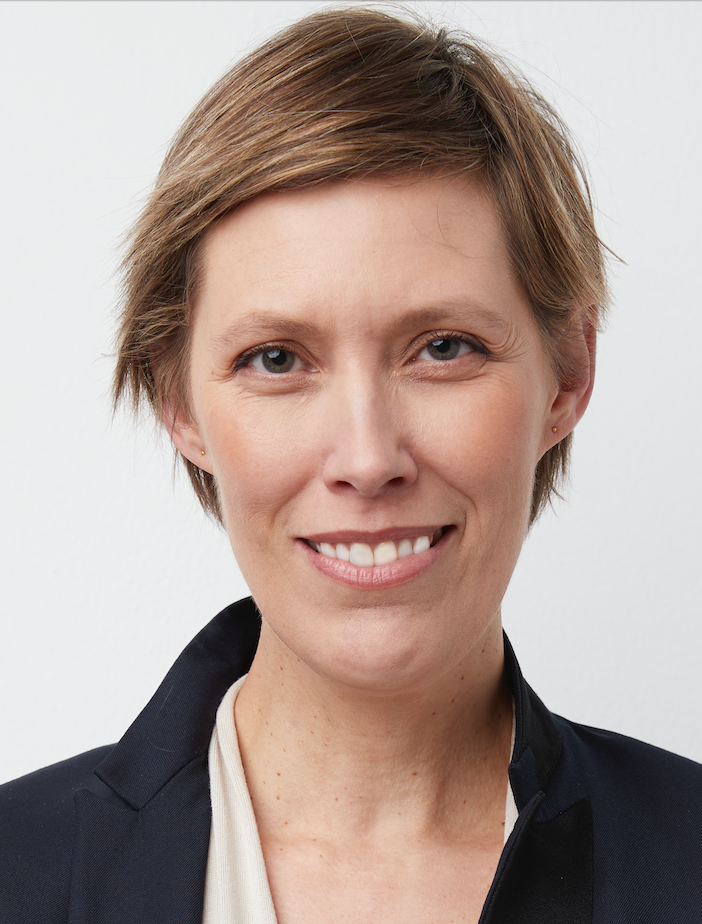
Davia de Croix
“For me, creativity and business thinking go hand in hand. You honor the legacy while building long-term equity.”
About Davia
Davia de Croix leads Global Brand Design at The Guggenheim, where she brings two decades of experience shaping brands across publishing, agency, and in-house worlds. Known for her cross-disciplinary approach and passion for beauty, fashion, and culture, she’s led teams that turn creative vision into measurable impact. Her collaborations with Prada, Tom Ford Beauty, and L’Oréal reflect a commitment to crafting work that resonates deeply and endures.
How was it transitioning from the agency world to a major museum?
I am drawn to brands where I feel I have something clear to contribute. That's what's always excited me, opportunities to help them grow or evolve the audience in a way that feels relevant to the moment.
I didn't see The Guggenheim much differently from that perspective. But as soon as I started telling people that I had left the agency world and was joining The Guggenheim, it was seen as a career change, which surprised me. But it's been a tremendous learning opportunity for me, not only being at a museum, but at a nonprofit with education at its core. That aspect is very different from working in a for-profit world where education isn't necessarily core to a mission or mandate.
I thought about this move the same way I would going from agency life back to being in-house. Specifically, by really living inside the brand again. It’s been almost ten years since I’ve done that, and it felt like a homecoming.
For me, creativity and business thinking go hand in hand. You honor the legacy while building long-term equity. You're driving results — engagement, growth, loyalty, brand love — while carrying the voice, protecting the integrity, and evolving the brand thoughtfully.
What's the most fun part of your new job?
I’m really excited about the level of investment in the future, particularly through educational outreach and reaching children. This involves creating meaningful programming, messaging, opportunities, and ways to experience and understand art.It's been so beautiful on a personal level to operate within those goals. So, I sort of pinch myself. I never would have imagined or pictured being a part of a conversation like that.
From a creative and brand standpoint, The Guggenheim is in an exciting moment of growth. We've just undertaken a brand identity refresh with the UK team at Pentagram. Now I get to think about how that iconic logo and mark apply to every communication touchpoint, not only in New York, but for Bilbao, and the Peggy Guggenheim Foundation, and soon Abu Dhabi.
We're starting to bring forward the idea of the Guggenheim as an international constellation, showing up to audiences both locally and more broadly with a fresh identity that can speak across communities and cultures in a new way.
What's an industry buzzword you can't stand?
I'm sure I fall into the jargon trap as much as anyone. There's a clubbiness to speaking the same language, even if it's made-up nonsense that doesn't really mean anything to anybody else.
A word I hear often in meetings is alignment. Everything needs to be aligned, and I get the need for consensus. But who sets the alignment? Is it adjustable and open to compromise, and is there subtext directed at specific stakeholders?
It was interesting to identify words with a completely different meaning in the museum world. One small example is the title "Producer," which is applied to many roles at the Guggenheim but raises bemused eyebrows among my media and commercial friends.
How did your early experiences inform your work today?
I have to thank the people I worked under for many years who were my mentors and teachers in so many ways. They instilled a rigorous sense of self-critique and discipline. Even though it was a long time ago for me, it was very formative in my career.
Magazine publishing was still at the top of its game and relevance in the mid-90s. It was at the end of a golden era. I was so fortunate that my first real magazine job was working with JFK Jr. at George, and then immediately going to work for Oliviero Toscani and George Lois, famous characters at the creative helm of Talk Magazine, which Tina Brown ran.
They were all incredible teachers, very generous and kind and patient, and very rigorous when it comes to professional standards. That was an excellent foundation for me. They came from a journalism background, and they had that point of view that this was not just about entertainment, this was about news, too. This is about the truth. Doing your research, reporting the facts, and recognizing that yes, there has to be a story for it to be compelling. Those are some of the tools I still rely on.
“Especially at a time when people feel sensitive about the dehumanizing potential of AI and other technologies, art becomes more important and relevant.”
What's a common pitfall you counsel brands to avoid?
Don’t let speed, or ubiquity, define you. It used to be that there was more of a runway, an incubation period where you could test ideas and grow them, but now everything feels global instantly, and it's like thumbs up, thumbs down. Crash and burn, or go viral.
That's not necessarily terribly satisfying for a creative trying to create a longer runway for storytelling in a brand's evolution and growth. I think it's a massive burden on creatives that every single creative gesture must automatically translate to commercial success.
The pragmatic challenge so many brands face is how to connect meaningfully with all the technology and the data points and not get stuck in paralysis.
I always go back to the simplicity and clarity of the message. Find the purpose and eliminate unnecessary channels. I'm not for being on every channel, everywhere, all at once, all the time, with everything, because it isn't easy to do that well or meaningfully. I can't think of a brand that stands out to me as succeeding in that, with that strategy.
What are the brand values? What are the goals? What's an experience people will value? How does everything else ladder into and facilitate that? Those answers allow for that magical leap off the edge into the next unknown growth period from a creative standpoint.
It sounds like we could use some of that alignment everybody's talking about.
Ha, yes it does! It's about finding the simplicity in the message, finding the essential truth, if you will. Now that I'm at the Guggenheim, it's an embarrassment of riches in the sense that there's a lot there to work with. I don't have to dig as deep to uncover the story. That's the hard work of the artist and the curator. I focus on the audiences.
More than ever, we have a desire and a need to reach as many people as possible. And that's the challenge, that's the nuance, because people have an idea of what art and culture and museums mean to them. My goal is to create an environment that's more inclusive and more welcoming, to cast a wider net and grow the audience.
Art is essential, and the ideas expressed in art are deeply inspiring. Especially at a time when people feel sensitive about the dehumanizing potential of AI and other technologies, art becomes more important and relevant. In the end, it always comes back to people — we create culture, making art is intrinsic to who we are.